Audiophile

Spherical waves
Horn dynamics. Re-shaped.

About fifty years ago, something emerged that hardly anyone could truly categorize
at the time. It was a world premiere – the first spherical-wave horn loudspeaker in this form language. A horn that does not end at the mouth, but is conceived as continuing into the room. Classic horns have always been able to fascinate: high efficiency, im- mediate dynamics, a directness that recalls live music. And yet for decades they car- ried a problem – coloration, compression artifacts, mouth reflections, and that elusive “horn signature” feeling that had less to do with music than with geometry. The real pro- blem was never the horn principle itself, but the transition. In traditional designs, the horn mouth ends abruptly – the surface stops, free air begins. Acoustically, that is a hard discontinuity: exactly where back-reflections into the horn body, edge diffraction, and interferences arise – later perceived as tonal coloration.
My idea was therefore simple, but radical: What happens if the horn does not end, but tapers out into a spherical geometry? If the wave does not hit an edge, but a continuous curvature that releases it into the room in a controlled way?

This is how the spherical-wave horn was created. The spherical termination defuses the most critical moment of the entire construttion – the transition from horn to room. Sound energy is not released abruptly, but guided. A very large mouth radius ensures that the expanding wave does not strike back, but can unfold evenly. Rotational symmetry significantly reduces side-specific artifacts and stabilizes directivity even off-axis.

The spherical embedding acts acoustically like an almost edge-free baffle, strongly minimizing typical baffle reflections. The result is not “horn sound,” but an unusually calm, coherent wavefront that does not lose energy – it concentrates it, without sounding “beamed.”

The central spherical-wave horn is complemented by geometrically related, scaled modules, so that a consistent acoustic language is maintained across multiple ways. Instead of a patchwork of different radiation characteristics, a structural unity emerges.

The crossover at around 800 Hz is delibe- rately chosen, because it is precisely in this range that many classic horn mouths tend
to produce back-reflections and comb-fil- ter-like artifacts. The spherical-wave form stabilizes this transition and makes it calmer, more homogeneous, and less “horn-typical,” without giving up the advantages of high efficiency.
What you ultimately hear is not a construc- tion, but sovereignty. Impulses arrive fast and clear, without the typical after-ringing at the horn mouth. Timbres remain stable, even at higher levels.

The phantom center locks in place because diffraction and mouth reflections are structurally reduced. High efficiency conveys power reserves not as pressure, but as composure. The system does not play loud – it plays effortlessly.

Even the external form follows this acoustic logic. Faceted surfaces, angled planes, and the clear mechanical separation between the spherical-wave modules and the bass section reduce standing waves and classic cabinet resonances. The sculptural appea- rance is not a design statement, but the expression of a physical consequence.

When this principle was first presented five decades ago, it was a technical provocation – a horn that does not end at the mouth, but understands the room as its continuation. Today we understand better that our hearing is not a pure frequency analyzer, but a highly sensitive instrument of time. Every reflection at the horn mouth is a time disturbance; every edge, a small untruth in the wave’s progression. The spherical-wave form addresses exactly that – fighting these disturbances at their source: the transition into the room.

The spherical-wave horn loudspeaker is therefore not an effect object and not a nostalgic quotation, but an attempt to unite dynamics, efficiency, and spatial precision with a form that takes the wave seriously. A horn that does not end at the mouth, but begins with the music.

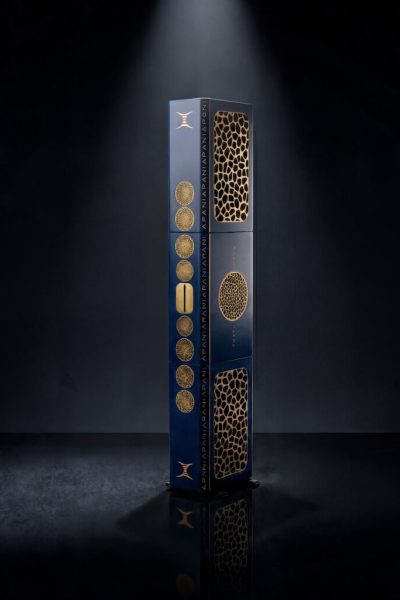
Apani Cairn

Different acoustical living rooms require different solutions. An authentic reproduction in a large room requires a com- pletely different solution to a small room. Long listening distances require different systems to near field situations.

So the loudspeaker cannot be one-size. It must be one-purpose.

Apani Cairn follows these requirements uncompromisingly in size and design. As a result, the external design is a function of the sound creation process. Organic sound creation pro- cesses are expressed in organic cabinet designs.

Not shaped to impress. Shaped to be true.

Cylindra V-CB

THE MUSIC TRANSFORMER

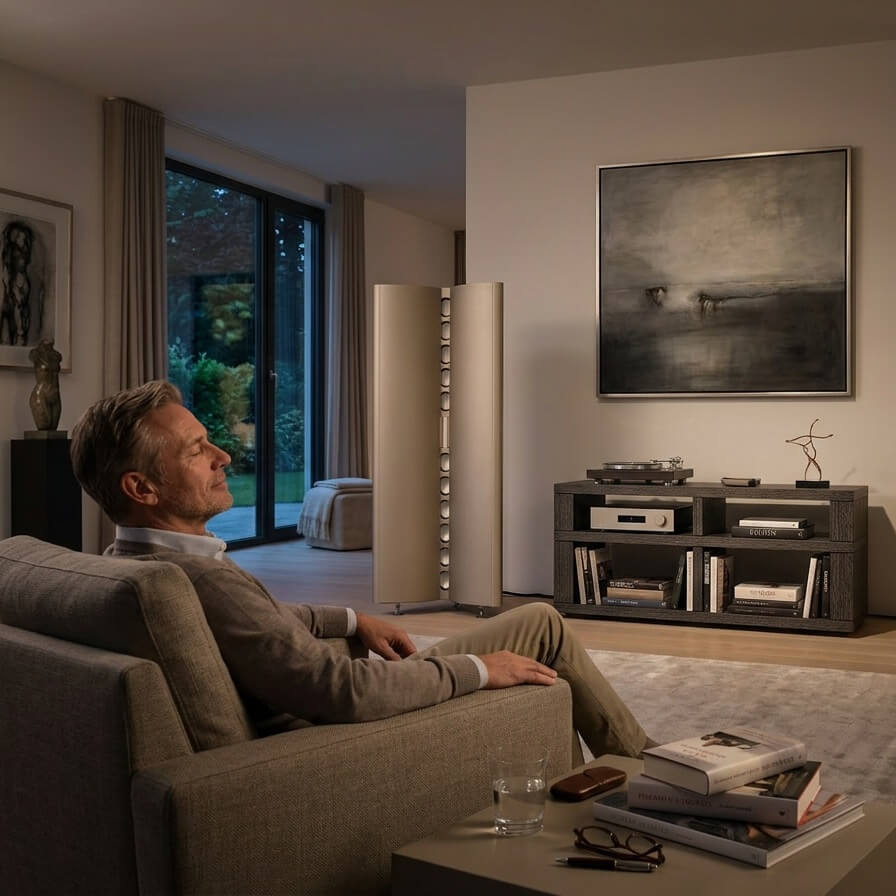
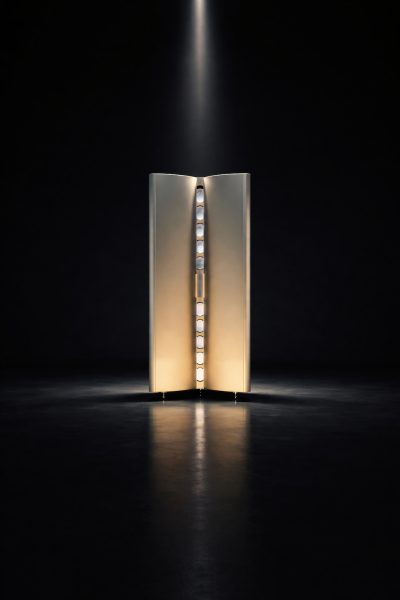
In a world filled with noise, Cylindra stands apart. Not as a loudspeaker – but as the Music Transformer. Where others reproduce sound, Cylindra transforms it: from electrical impulse to living emotion, from vibration to presence, from recording to pure experience.

Its vertical wave architecture, the bionic resonance control, and the meticulously hand-tu- ned frequency signature merge into a single purpose: to translate the intention of the artist into the language of your senses.

Every Cylindra is individually fine-adjusted in its future listening room – calibrated to the geometry, the materiality, and the personal hearing fingerprint of its owner.

No two rooms are equal.
No two listeners are equal.
So no two Cylindras are ever the same.
German engineering meets the Apani philosophy: As Pure As Nature Intended.

The Music Transformer embodies this promise.
It is the bridge between art and perception,
between the measurable and the magical.
A loudspeaker is a machine. Cylindra is a transformation. A re-creation of music in its purest, most natural form.

APANI CYLINDRA – The Music Transformer. Where sound becomes truth.

Iona

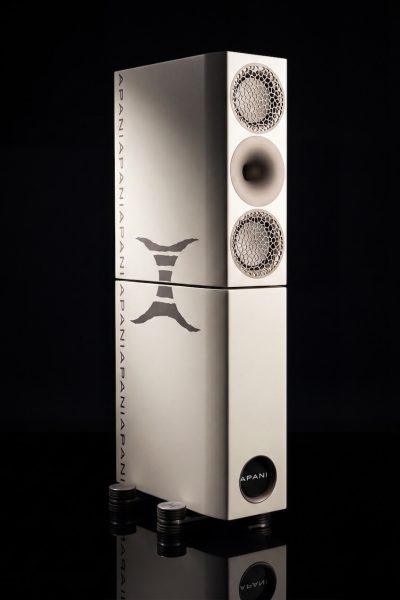
IONA is conceived as a monolithic musical body.

A calm, architectural presence. Soft radii, continuous surfaces, no visual noise. Nothing shouts. Nothing decorates. Everything serves function.

The front composition reveals its intention immediately: two symmetrically placed transducers, framing a central acoustic waveguide– not as a horn for effect, but as a controlled opening for air and time.

IONA does not project sound. It releases it.

The composite bionic lattice grilles are not ornament. They function as acoustic high- resolution lenses– organic, irregular, alive– inspired by natural cellular structures.

They shape, diffuse, and resolve sound with precision,
just as nature does when nothing is forced.
IONA stands upright like a musical column. Stable. Grounded. Silent before it speaks. And when it speaks, it does not add anything.

It transforms.

Iona x Fjord

ONE BODY. ONE VOICE.

Together, IONA and FJORD form a modular musical architecture. Unified in character. Free in placement. Whether vertically aligned or spatially distributed like sculptures, the system preserves a single voice. Only the relationship to space changes.

THE FOUNDATION EXTENSION

FJORD is the lower continuation of IONA’s body.

Not a subwoofer. Not an add-on. Not a separate product.

It is the ground beneath the column.

Visually, FJORD repeats the same calm geometry, the same soft transitions,
the same composite bionic lattice grilles– now operating as acoustic high-resolution lenses scaled for mass and authority.

The side-mounted radiating surface is intentional: bass does not need to point.
Bass needs to couple.

FJORD does not pressurize the room. It anchors it.

Auris V

THE ART OF INTIMATE LISTENING

Not every musical truth needs a large room. Some truths unfold best at close distance – where tone, timing and space meet the listener directly.

With Auris V, Apani introduces a compact audiophile listening instrument designed for music lovers who seek clarity without coldness, precision without analysis, and emotion without exaggeration.

Auris V is not a studio monitor. It is a listening companion.

One Sound. One Origin.

At the heart of Auris V lies the Apani UniCoreTM Architecture – a single acoustic source where all frequencies emerge from one natural center.

This principle mirrors how sound exists in nature: not separated, not layered, but coherent.

The result is a soundstage that feels stable, calm and believable. Voices remain anchored. Instruments breathe freely.
Music unfolds without effort.

Auris V Sub

BASS EXTENSION – TRUTH, NOT WEIGHT.

Bass is not supposed to be “more.” Bass is supposed to be right.

AURIS SUB is the low-frequency extension for the Auris family
– designed to complete the system without changing its character. Not to inflate the room. Not to add drama.

But to restore what the recording actually contains: foundation, scale, and calm authority.

Bass as a moment in time

Most subwoofers add weight by adding after-movement. They feel impressive for a minute – then the room takes over: boom, smear, one-note resonance.

AURIS SUB follows a different principle: fast start, clean stop.

Because when the low end is time-true, everything above it becomes clearer. Voices stabilize. Imaging locks in. Rhythm becomes inevitable.